Overview
GWDALI (Gravitational Wave Derivative Approximation for Likelihoods) is an open-source Python package developed to perform parameter estimation of gravitational wave (GW) sources beyond the standard Gaussian (Fisher Matrix) approximation, using the Derivative Approximation for Likelihoods (DALI) method.
GWDALI 1.0 is the culmination of work published in two peer-reviewed papers:
- de Souza, J. M. S., & Sturani, R. (2023). Astronomy and Computing, 45, 100759. arXiv:2307.10154
- de Souza, J. M. S., & Quartin, M. (2026). JCAP, 2026(05), 101. arXiv:2510.16955
Motivation
GW parameter estimation is a challenging problem: a compact binary coalescence (CBC) signal is described by 15 physical parameters (masses, spins, sky position, luminosity distance, orientation, etc.), and the GW waveform models are computationally expensive.
The standard approach — the Fisher Matrix — approximates the likelihood as a multivariate Gaussian. This works well at high signal-to-noise ratio (SNR), but fails for few-detector networks and strongly correlated parameters such as the luminosity distance \(d_L\) and inclination angle \(\iota\). In those regimes, Fisher-based posteriors can be orders of magnitude off from the exact likelihood.
DALI solves this by extending the Taylor expansion of the log-likelihood to higher orders, capturing non-Gaussian features of the posterior at a fraction of the computational cost of MCMC.
The DALI Method
DALI expands the log-likelihood beyond the Fisher (quadratic) level:
\[ \log\mathcal{L} \approx -\frac{1}{2}\sum_{i,j}\langle \partial_i h | \partial_j h \rangle_0 \Delta\theta^i \Delta\theta^j \quad \text{[Fisher]} \] \[ - \frac{1}{2}\sum_{i,j,k}\langle \partial_i h | \partial_{jk} h \rangle_0 \Delta\theta^{ijk} + \frac{1}{8}\sum_{i,j,k,l}\langle \partial_{ij} h | \partial_{kl} h \rangle_0 \Delta\theta^{ijkl} \quad \text{[Doublet]} \] \[ - \frac{1}{6}\sum_{i,j,k,l}\langle \partial_i h | \partial_{jkl} h \rangle_0 \Delta\theta^{ijkl} + \cdots \quad \text{[Triplet]} \]
GWDALI implements Fisher, Doublet and Triplet orders, with support for automatic differentiation (JAX) and numerical derivatives.
Key Functionalities
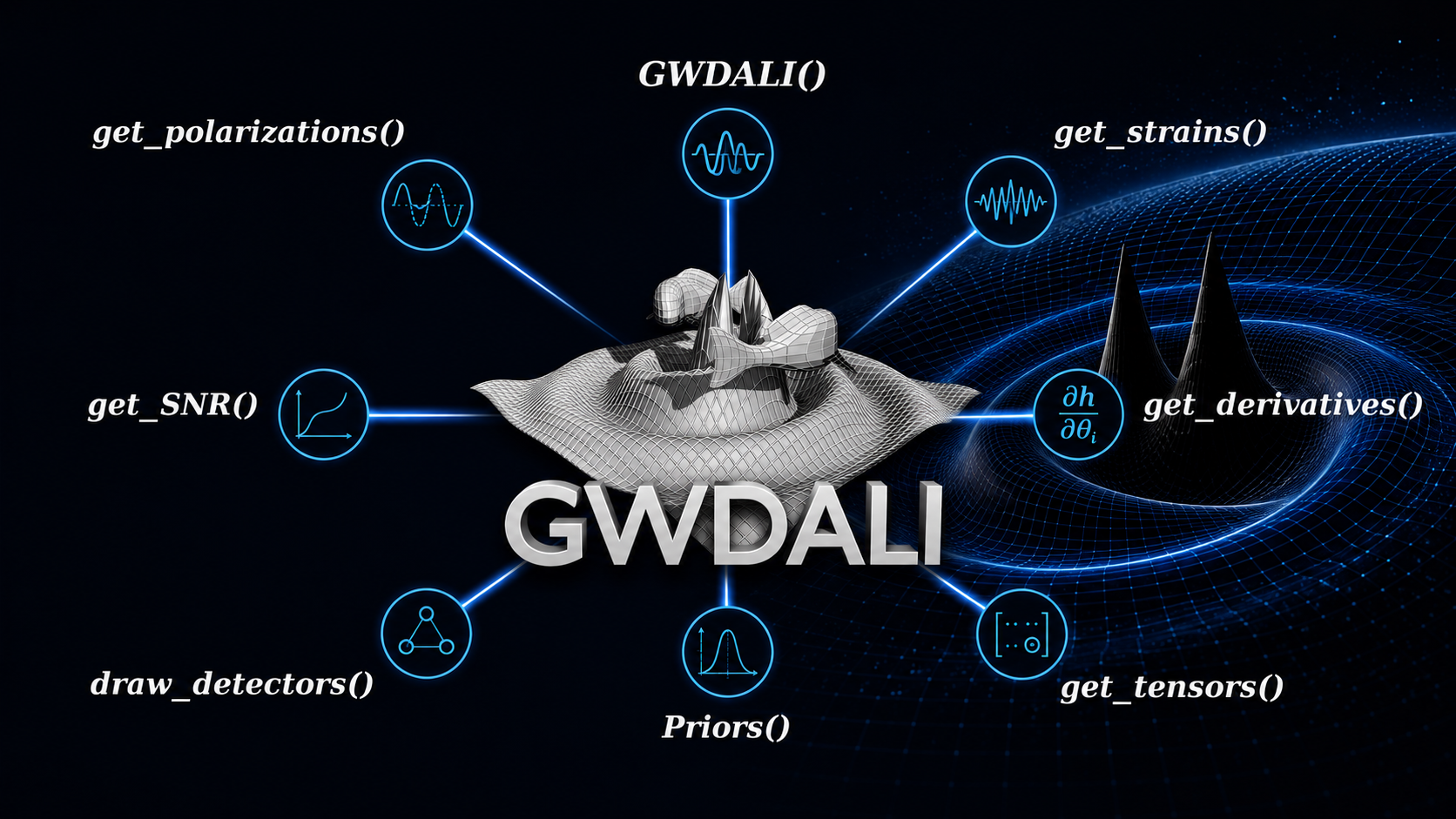
GWDALI provides a modular Python API centered on the GWDALI() class:
| Function | Description |
|---|---|
get_polarizations() |
Compute GW polarizations \(h_+\), \(h_\times\) |
get_strains() |
Compute detector strains \(F_+h_+ + F_\times h_\times\) |
get_SNR() |
Compute signal-to-noise ratio |
get_derivatives() |
Waveform derivatives \(\partial h / \partial\theta_i\) (numerical or JAX autodiff) |
get_tensors() |
Fisher, Doublet and Triplet tensors |
Priors() |
Define and sample prior distributions |
draw_detectors() |
Visualize detector network geometry |
Detector Networks & Sensitivities
GWDALI supports user-defined detector networks, with built-in sensitivity curves for:
- Einstein Telescope (ET) — triangular 10 km detector
- Cosmic Explorer (CE) — 20 km and 40 km L-shaped detectors
- LIGO, Virgo, KAGRA
Users can also supply custom sensitivity curves as (freq, Sn) arrays, enabling forecasts for any proposed detector configuration.
Waveform Approximants
GWDALI includes JAX-friendly implementations (translated from LAL-C) for automatic differentiation:
TaylorF2IMRPhenomA,B,C,D,HM
For broader coverage, all LALSimulation waveforms are accessible via lalsimulation, with numerical derivatives computed automatically.
GW Source Parameters
GWDALI characterizes CBC sources through 15 physical parameters:
| Parameter | Symbol |
|---|---|
| Luminosity Distance | \(d_L\) |
| Inclination | \(\iota\) |
| Chirp Mass | \(\mathcal{M}_c\) |
| Symmetric Mass Ratio | \(\eta\) |
| Right Ascension | \(\alpha\) |
| Declination | \(\delta\) |
| Polarization Angle | \(\psi\) |
| Coalescence Phase | \(\phi_c\) |
| Coalescence Time | \(t_c\) |
| Spins (x, y, z) of each object | \(\vec{\chi}_1\), \(\vec{\chi}_2\) |
Installation
pip install gwdaliFull documentation and Jupyter notebook examples are available at:
- 📖 Docs: gwdali.readthedocs.io
- 📦 PyPI: pypi.org/project/gwdali
Jupyter Notebook Examples
GWDALI ships with worked examples covering all major functionalities:
1_get_hphx.ipynb— Compute GW polarizations2_drawDetectors.ipynb— Visualize detector networks3_get_strains.ipynb— Compute detector output4_get_derivatives.ipynb— Waveform derivatives (numerical & JAX)5_get_tensors.ipynb— Fisher, Doublet and Triplet tensors6_GWDALI_MCMC_Fisher-vs-Single.ipynb— Full posterior comparison (Fisher vs. DALI vs. MCMC)
Results & Validation
GWDALI has been validated against exact MCMC posteriors using Jensen–Shannon divergence as a metric. For 300 simulated BBH detections with the Einstein Telescope (SNR > 8):
- Fisher (inversion) often fails for parameters such as \(d_L\) and \(\iota\) due to strong correlations
- DALI Doublet significantly improves the posterior approximation over Fisher
- DALI Triplet further refines the approximation, approaching MCMC accuracy at much lower cost
- Alternative parameterizations (e.g., \(1/d_L\), \(1/d_L^2\)) can extend DALI’s validity range
Conclusions & Outlook
- Traditional Fisher analysis fails for GW posteriors in low-SNR or strongly correlated regimes
- DALI provides a computationally efficient alternative, capturing non-Gaussian features
- GWDALI 1.0 is fully open-source and actively maintained
- Ongoing work: optimization of derivative computations (the main bottleneck), extension to all 15 GW parameters, and further validation against 3G detector networks